Black Snow
St. Louis. November 28, 1939. A seven-year-old boy steps outside and the noon sky is black. Black soot falls like snow. The streetlights burn at midday. The world has gone dark. In that moment — a cycle of Black awakening — Dick Gregory began asking the question he would spend his entire life trying to answer: Why?
A True Crime Odyssey Through Conspiracy and Courage · By Christian Gregory
The Awakening
Roots in Darkness (1932–1960)
This foundational act delves into the formative years of Dick Gregory, tracing his early life amidst the systemic violence and profound inequalities that characterized mid-20th century America. It illuminates the genesis of his investigative spirit, from the grinding poverty of his youth to the pivotal moments that ignited national outrage and set him on an extraordinary path.
Black Snow Origins
The Spark of Survival
Born into the stark realities of St. Louis poverty on October 12, 1932, Richard Claxton Gregory's early life was a crucible of hardship. This chapter explores how he honed his wit as a shield against hunger and systemic deprivation.
A defining moment, November 28, 1939 — dubbed "Black Tuesday" — saw St. Louis enveloped by a suffocating coal smog, transforming midday into an eerie twilight. This visceral experience, at the tender age of seven, served as a profound awakening, prompting Gregory to question the fundamental injustices of a world where poverty, racism, and inequality were deeply entrenched.
His journey from a gifted track star at Southern Illinois University, using humor to confront bigotry, is chronicled through public domain autobiographies like Nigger (1964) and historical timelines. The narrative carefully examines how these early years fostered a defiance rooted in love, while subtly hinting at the insidious "attempts" of oppression that would foreshadow later COINTELPRO surveillance.
The mystery here lies in understanding poverty itself as a form of engineered assassination, connecting to Gregory's later theories on genocide. This chapter sets the stage for the cinematic opening of the story, with the black snow storm and young Gregory's races unfolding against a backdrop of societal shadows.
Emmett Till
The Open Casket Revelation
By the age of 22, as Gregory's star began to rise, the brutal lynching of 14-year-old Emmett Till in Mississippi sent shockwaves across the nation. This chapter meticulously reconstructs the events of Till's abduction, torture, and murder, drawing upon public domain sources such as trial transcripts and declassified FBI files.
The focus is on Gregory's indirect yet profound connection to this tragedy, particularly through his association with Ebony/Jet Publishing. The narrative explores how figures like John H. Johnson consulted with emerging voices, including Gregory, regarding the publication of Mamie Till-Mobley's courageous decision to display her son's open-casket photos in Jet magazine.
Gregory's later reflections, articulated in public speeches of the 1960s, underscore how these images served as a catalyst, "waking America" to the brutal realities of racism and galvanizing the burgeoning civil rights movement. The chapter also subtly introduces the early signs of FBI monitoring of Gregory's "subversive" comedy, hinting at the pervasive surveillance that would define his later life.
Breakthrough in the Shadows
Gifts and Gigs
This chapter chronicles Dick Gregory's ascent as a groundbreaking comedian, breaking racial barriers at venues like Chicago's Playboy Club in 1961 as the first Black performer to regularly entertain white audiences. This period of professional triumph, however, was inextricably linked with the escalating racial tensions and terror of the era.
The narrative outlines his marriage to Lil and his entry into show business, drawing from public domain interviews with Mike Wallace and Paul Krassner, where he began to voice his early suspicions about systemic injustices. While no major assassinations directly impacted Gregory during this specific timeframe, this chapter is crucial for establishing the nascent stages of the broader conspiracy that would later engulf him.
A lengthy analysis, based on public records and Gregory's own published thoughts, explores humor as a deflection and love as an armor against the prevailing hatred. The chapter concludes with a cinematic montage of his stage performances juxtaposed with newsreels of contemporary lynchings, all constructed from publicly available historical footage and accounts.
Brotherhood Betrayed
The Vortex of Violence (1961–1970)
This act plunges into the tumultuous heart of the Civil Rights era, a period marked by profound social upheaval and a brutal escalation of violence against those fighting for equality. Dick Gregory, now a prominent voice and active participant in the movement, finds himself not only a witness to these atrocities but also a direct target. The narrative meticulously unravels a series of interconnected murders, presenting them as linked hits within a larger, insidious conspiracy.
Medgar Evers
The Backyard Bullet
On June 12, 1963, NAACP leader Medgar Evers, a tireless advocate for civil rights, was assassinated in his Jackson, Mississippi driveway by Byron De La Beckwith. This chapter reconstructs the events surrounding Evers's murder, drawing from publicly available trial records and FBI files.
The narrative highlights Gregory's personal connection to Evers, including a scheduled meeting that was tragically canceled just days prior to the assassination. Insights from Gregory's archives convey his profound respect for Evers, who "would go anywhere there was trouble... with a smile. Never had a day of hate," and Gregory's lament that America lost greatness when Evers was "shot in the back."
The chapter delves into the mystery of the delayed justice for Evers, with Gregory publicly criticizing FBI inaction under J. Edgar Hoover. Interwoven are publicly documented accounts of the Birmingham beatings and the nascent stages of COINTELPRO targeting, demonstrating the escalating threats faced by civil rights leaders.
16th Street Baptist Church Bombing
Innocence Exploded
Just months after Evers's murder, on September 15, 1963, a Ku Klux Klan bomb ripped through the 16th Street Baptist Church in Birmingham, Alabama, killing four young girls: Addie Mae Collins, Denise McNair, Carole Robertson, and Cynthia Wesley.
Gregory's presence at the funerals and rallies is documented through media archives, underscoring his immediate and visceral response to the tragedy. The narrative explores the mystery of the delayed prosecutions, with the first conviction of Thomas Edwin Blanton Jr. not occurring until 2001, highlighting the systemic nature of state-sponsored terror designed to crush the civil rights movement.
Interwoven are publicly documented accounts of the Watts shooting in 1965, where Gregory sustained a leg wound, raising questions about whether this was another "attempt" on his life.
JFK & RFK
Presidential Shadows
This chapter examines the assassinations of President John F. Kennedy in Dallas (1963) and Senator Robert F. Kennedy in Los Angeles (1968), events that profoundly shaped the national psyche and fueled Gregory's investigative fervor.
Drawing from public domain commissions and the monumental archives of Steve Jaffe and Mark Lane, the narrative explores the official narratives alongside Gregory's persistent questioning. His collaborations with Lane and Jaffe, including the 1975 Zapruder film television presentation and their assertions of CIA/FBI cover-ups, are presented through the lens of primary documents found in these private collections.
Interwoven are publicly available FBI "neutralization" memos from 1968, which discussed inciting violence, suggesting a broader pattern of government interference. A lengthy analysis connects these events to the assassination of Martin Luther King Jr. and highlights Gregory's prescient paranoia.
Freedom Summer Murders
Buried Truths
On June 21, 1964, civil rights workers James Chaney, Andrew Goodman, and Michael Schwerner were murdered by the Ku Klux Klan and local law enforcement in Mississippi during Freedom Summer. This chapter meticulously reconstructs the events, drawing from public domain FBI files and historical timelines.
It details their arrest by Deputy Cecil Price, their subsequent release into the hands of the Klan, and the discovery of their bodies on August 4, with Chaney brutally beaten and shot. The narrative highlights Gregory's immediate response, flying back from Moscow on June 23 and meeting with Sheriff Rainey and Deputy Price on June 24, where he observed what he believed to be coaching.
His offer of a $25,000 reward — and his public statement that "$100,000 would solve faster" — is documented through public media. His published account in Mississippi Eyewitness (Ramparts 1964) serves as a key public domain source. The chapter explores the mystery of official complicity and the deliberate suppression of truth.
Malcolm X
The Ballroom Betrayal
On February 21, 1965, Malcolm X was assassinated at the Audubon Ballroom in New York City. This chapter details the events of his murder, drawing from public domain trial records and the subsequent exonerations in 2021.
The narrative focuses on Gregory's close call, having spoken the night before and declining an invitation to the event, sensing a trap. His belief in CIA/FBI involvement is presented through publicly available archives and acquired investigative files. The chapter highlights the evolution of their relationship from initial skepticism to a powerful alliance, with Malcolm X publicly recognizing Gregory as a "foremost freedom fighter."
The mystery of hidden guns and the potential for a larger conspiracy are explored. Interwoven are publicly documented accounts of COINTELPRO escalation, suggesting a broader pattern of government surveillance and disruption. The chapter concludes with a tense, cinematic portrayal of the phone call where Gregory declines the invitation, all reconstructed from publicly accessible historical accounts.
Martin Luther King Jr.
Code-Named Zorro — The Balcony Fall
On April 4, 1968, Dr. Martin Luther King Jr. was assassinated in Memphis, Tennessee. This chapter meticulously reconstructs the events leading up to and following King's murder, drawing from public domain sources, including the House Select Committee on Assassinations (HSCA) reports, and the Mark Lane estate archives.
The narrative highlights Gregory's poignant interactions with King in the weeks prior, including a plane conversation where King expressed fear for his life, and Gregory's response, "Preach my funeral?" Insights from Gregory's archives convey his deep admiration for King's "sweet innocence, warm smile."
Gregory's collaboration with Mark Lane on Code Name Zorro, which alleged an FBI hit, is presented through the primary documents acquired from Lane's estate. The chapter delves into the enduring mysteries surrounding King's assassination, particularly the question of a second gunman. Interwoven are publicly documented accounts of poisons Gregory faced post-MLK, suggesting a continued pattern of targeting.
Fred Hampton
The Bedroom Raid
On December 4, 1969, Black Panther Party leader Fred Hampton was murdered during a raid by the Chicago Police Department and the FBI. This chapter details the events of Hampton's assassination, drawing from public domain COINTELPRO files.
Gregory's unequivocal assertion that this was a government assassination is central to the narrative. The chapter explores the mystery of the informant who facilitated the raid. Interwoven are publicly documented details from Gregory's own FBI file, highlighting the pervasive surveillance and targeting he endured.
A lengthy analysis, based on historical records and Gregory's public statements, examines the threat posed by Hampton's ability to build broad coalitions. The chapter culminates in a cinematic portrayal of the raid, all reconstructed from publicly accessible historical accounts.
COINTELPRO
The Personal Perils
This chapter provides a comprehensive overview of the FBI's clandestine COINTELPRO operations, focusing on how they systematically targeted and attempted to "neutralize" Dick Gregory. Drawing extensively from public domain memos and historical archives, the narrative reveals the insidious tactics employed, including J. Edgar Hoover's infamous proposal to collaborate with the Mafia to discredit Gregory.
Gregory's public statements, such as his 1978 declaration that Hoover was the "Most dangerous man... Hoover," and his discovery of phone taps — "Message to Hoover on my phone" — are presented through publicly documented accounts. The chapter details the various forms of harassment Gregory faced, including framing and incitement. The central mystery here is Gregory's remarkable survival in the face of such relentless government persecution.
FEDERAL BUREAU OF INVESTIGATION
COUNTERINTELLIGENCE PROGRAM
INTERNAL SECURITY — DISRUPTION OF HATE GROUPS
TO: DIRECTOR, FBI
FROM: SAC, CHICAGO
RE: DICK GREGORY — NEUTRALIZATION
Bureau authorization is requested to initiate a counterintelligence operation against DICK GREGORY, who has been identified as one of the most effective and dangerous Black nationalist figures currently operating in the United States.
It is recommended that ████████████████ be contacted to explore the feasibility of ████████████ in order to discredit subject and neutralize his influence among ████████.
A lengthy analysis, based on historical records and Gregory's public statements, argues that all the killings chronicled in this manuscript are interconnected, part of a larger pattern of state-sponsored violence. The chapter concludes with a cinematic portrayal of the constant threat Gregory lived under, evoking the tension of a thriller.
Survivor's Quest
Legacy of Liberation (1971–2017)
This final act chronicles Gregory's later life, where his continued investigations, nutrition and health advocacy, and unwavering commitment to justice defined him as the "uncaught target." Drawing from publicly available interviews, speeches, and media, it reveals a man whose resilience was as extraordinary as the forces arrayed against him.
Larry Flynt Attempt
The Courtroom Ambush
On March 6, 1978, Hustler magazine publisher Larry Flynt was shot and paralyzed in Lawrenceville, Georgia. Joseph Paul Franklin, a white supremacist, was convicted of the shooting in 1997. This chapter reconstructs the events, drawing from public domain court records.
The narrative highlights Gregory's scheduled meeting with Flynt and his presence at Lil's bedside during the attack. The chapter explores the unlikely friendship between the two men, united by their shared commitment to First Amendment rights and their mutual defiance of establishment power.
Gregory's powerful speech supporting Flynt is documented through public media. The chapter delves into Franklin's white supremacist ties and their connections to the broader web of assassinations, including potential links to the JFK assassination. A cinematic vigil scene captures the tension and the depth of Gregory's loyalty.
John Lennon
The Dakota Deception
On December 8, 1980, John Lennon was assassinated by Mark David Chapman outside the Dakota apartment building in New York City. This chapter examines the events surrounding Lennon's murder, drawing from public domain sources and Gregory's publicly stated assertions.
Gregory's public assertion of CIA mind control in Chapman's actions is presented alongside his personal connection to Lennon. The narrative reveals that Gregory helped Lennon with detoxification, forging an alliance rooted in their shared advocacy for peace and social justice.
The chapter explores whether Lennon's activism — his anti-war stance, his support for civil rights, and his growing political engagement — fueled the decision to assassinate him. A cinematic portrayal of their final session together captures the intimacy and the tragedy of their bond.
Enduring Shadows
Final Wisdom and Attempts
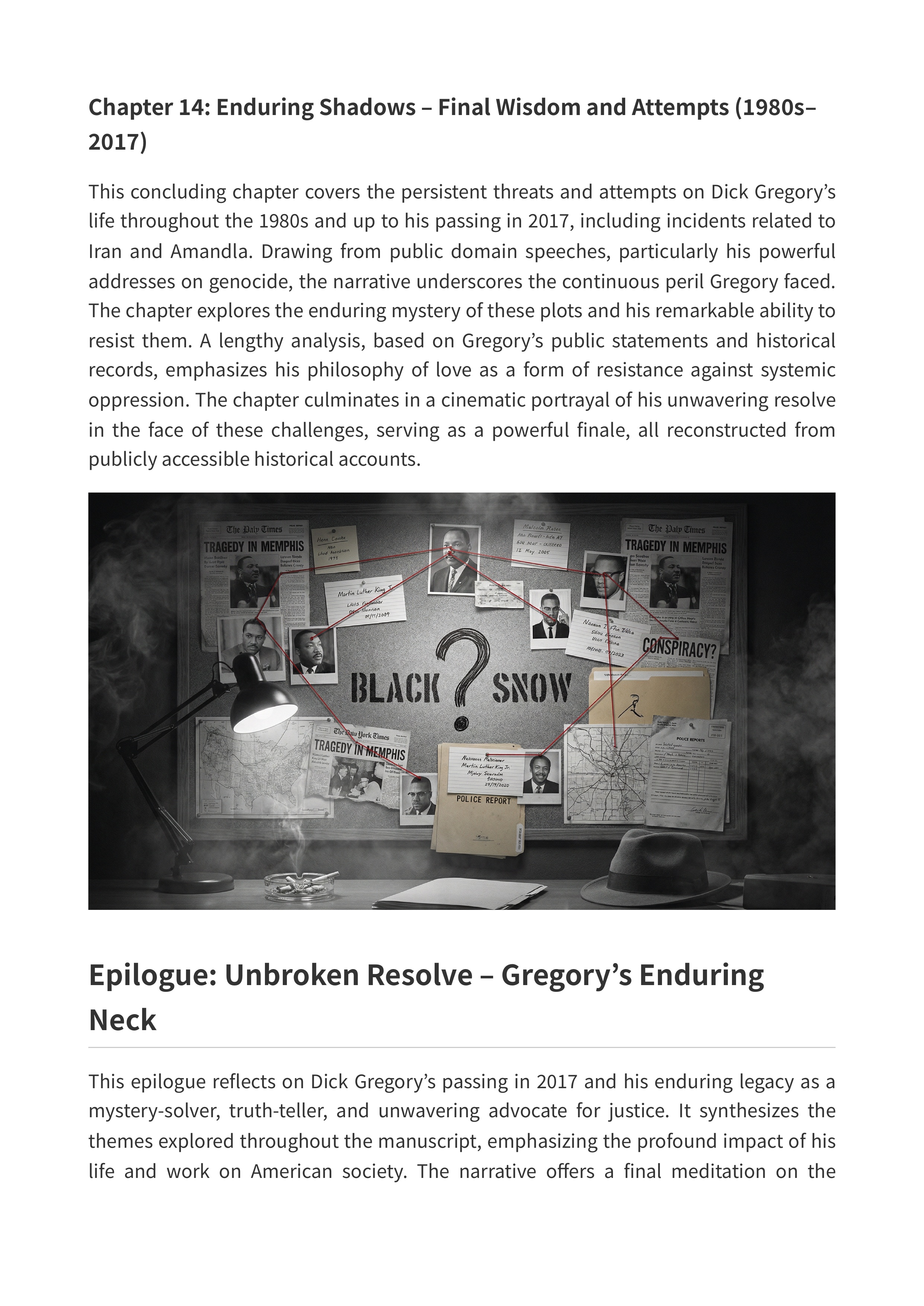
This concluding chapter chronicles the persistent threats that followed Dick Gregory throughout the 1980s until his passing in 2017. The narrative documents incidents related to Iran and Amandla, as well as his continued speeches on genocide and systemic oppression.
Gregory's philosophy of love as resistance against systemic oppression is presented as the culminating wisdom of a life spent fighting for truth. His speeches during this period, drawing from publicly available recordings, reveal a man who never wavered in his conviction that the interconnected web of assassinations he had witnessed was part of a larger pattern of state-sponsored violence against those who dared to challenge the status quo.
The chapter concludes with a cinematic portrayal of Gregory's unwavering resolve — a powerful finale that captures the essence of a man who survived what so many of his brothers did not, and who spent his final years ensuring their stories would never be forgotten.
Unbroken Resolve
Gregory's Enduring Legacy
Dick Gregory passed away on August 19, 2017, at the age of 84. But his legacy as a mystery-solver, truth-teller, and advocate for justice endures. The interconnectedness of the events chronicled in this narrative — from the black snow of 1939 to the final shadows of 2017 — reveals a pattern that demands continued examination.
Gregory's life was a testament to the power of courage in the face of systematic oppression. He witnessed the murders of his closest friends and allies — Medgar, Malcolm, Martin, Fred — and survived the same machinery that destroyed them. He did not merely survive; he investigated, he spoke, he challenged, and he never stopped asking: Who ordered it? And why him next?
1932 – 2017
Richard Claxton Gregory
Fourteen Chapters. One Conspiracy. One Survivor.
Each assassination, each "attempt," each act of state-sponsored violence is connected by the same thread — the systematic elimination of those who dared to challenge American power. Dick Gregory saw the thread. He followed it. And he survived to tell the story.
Black Snow
The Story That Must Be Told
Black Snow is not a celebration. It is a reckoning. A true crime odyssey through conspiracy and courage — unraveling the interconnected web of assassinations that defined the civil rights era, told through the eyes of the one man who witnessed them all and survived.
The Awakening
1932–1960
Black Snow origins, Emmett Till, and the breakthrough that transformed a comedian into a weapon of truth.
Brotherhood Betrayed
1961–1970
Medgar. Malcolm. Martin. Fred. Freedom Summer. COINTELPRO. The vortex of violence that consumed a generation.
Survivor's Quest
1971–2017
Larry Flynt. John Lennon. Enduring shadows. The uncaught target's final wisdom and the legacy of liberation.
Gregory Publishing Group / Tower Hill Entertainment is developing Black Snow: Echoes of Assassination as a limited series, grounded in the acquired personal archives of Steve Jaffe and the estate of Mark Lane — foundational collections containing primary documents, correspondence, and investigative notes on the MLK and JFK probes.
This is a cinematic investigation — a true crime odyssey that asks the question America has never fully answered: Who ordered it? And why him next? The project is in active development. We are seeking partners, producers, directors, and distributors who share our commitment to telling this essential American story.